New
and Used
Cars Have Fuel Problems

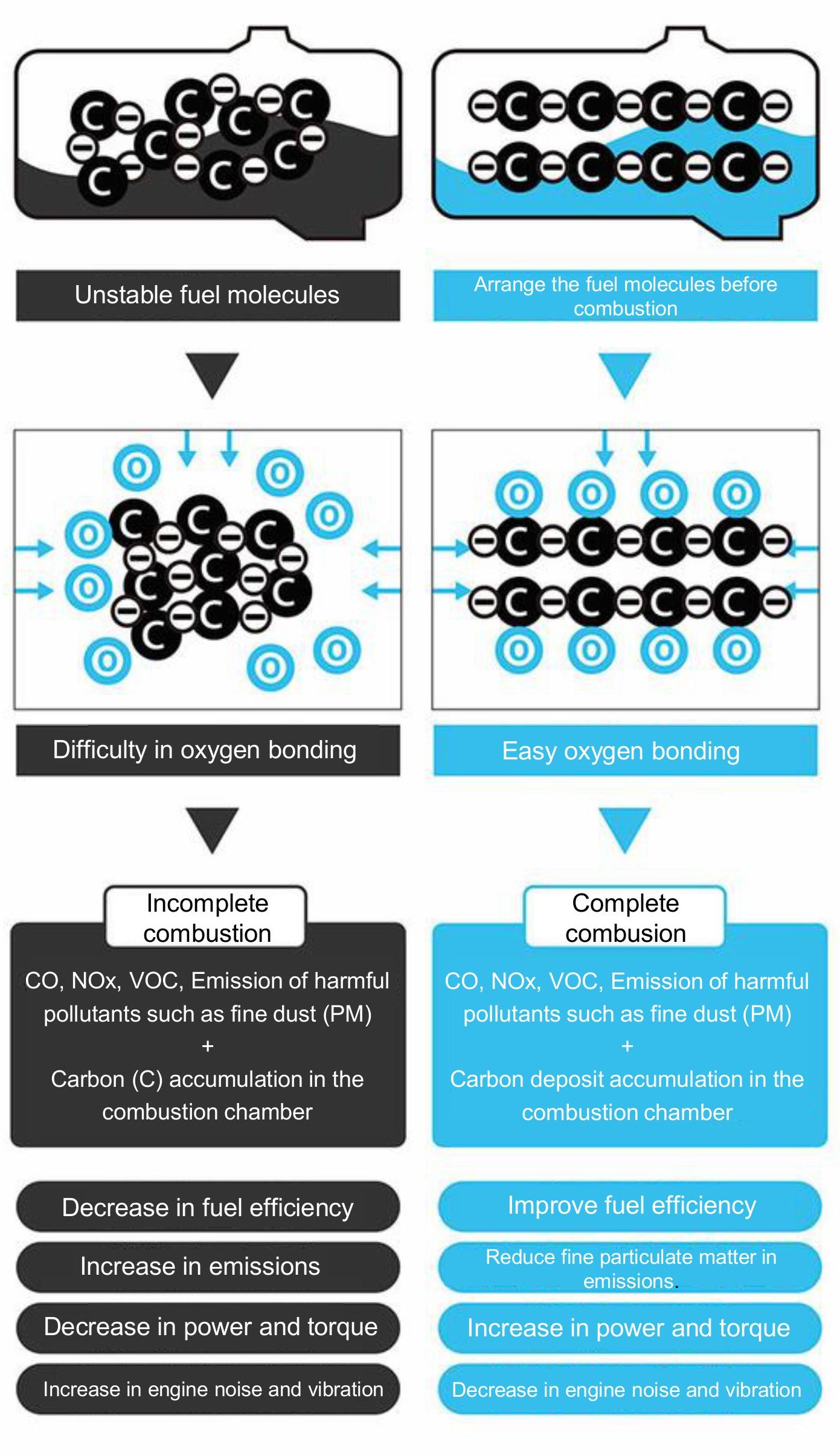
Carbon-based fuels are almost impossible to fully combust inside an engine.

Carbon molecules form strong bonds, making it difficult for the fuel to burn completely. Unburned fuel residues accumulate around injectors, intake valves, and exhaust valves.

Should we use fuel additives to remove carbon and clean the engine, or should we continue to spend a lot of money on engine flushing?

Even after cleaning, residues will accumulate again, and the cycle of cleaning them will repeat.

In 1954, Chevron, an American oil refining company, was the first to add surfactants (Cleic Acid Amid, amine compounds) to fuel to clean carbon deposits caused by incomplete combustion of fuel in engines.

Subsequently, cleaning agents such as Poly Isobutenyl Succinic Acid Imide (PISAI) in 1968 and Polybuteneamine (PBA) in 1970 were developed. In 1980, PEA (Polyetheramine), which is the main component of most fuel additives today, was developed.

Gasoline and diesel fuel sold at regular gas stations already contain these cleaning components, such as PEA, PBA, PISAI, and alkylphenol amine, as well as MTBE (Methyl Tert-Butyl Ether), EHN (2-Ethyl Hexyl Nitrate), and lubricity improvers.

Refining companies already carefully add only the necessary amount of cleaning agents to fuel after thorough testing.

This is because excessive cleaning agents can damage rubber and plastic components, and PEA, which has a higher flash point than fuel, can flow under the engine and thin out the engine oil, potentially causing side effects.

In recent years, cutting-edge AI technology has been applied to vehicles that was unimaginable 40 years ago.

However, are fuel additives still limited to PEA cleaning, which is prone to side effects and was developed 40 years ago?

DURAVO

01

“COMPLETE COMBUSTION PROMOTION”


Unlike conventional fuel additives that focus on cleaning carbon residues after combustion, DURAVO takes a unique approach. It interacts with the carbon molecules in the fuel, optimizing their interaction with oxygen within the combustion chamber, thereby promoting complete combustion.

02

“NON-TOXIC”


DURAVO is a non-toxic fuel additive that contains no cleaning agents and is environmentally friendly.

Within 5 minutes of adding DURAVO, a change in vehicle performance can be expected, and a reduction in exhaust gas emissions can be expected within 30 minutes.

PRINCIPLE OF OPERATION

VOLVO Truck Customer

「In the two months of using DURAVO, I have experienced very strong performance when climbing hills. The fuel efficiency is also good, the urea solution cost has been reduced, and I am truly very satisfied」

DURAVO’S EFFORTS FOR THE ENVIRONMENT

DURAVO is at the forefront of research dedicated to addressing the pressing environmental challenges faced by humanity. Automotive exhaust emissions and particulate matter have long been a persistent concern, impacting air quality and contributing to global environmental issues.

DURAVO’s regular use optimizes the performance of a vehicle’s fuel system, lubrication system, and exhaust system, promoting complete combustion of fuel. This results in a significant reduction in exhaust emissions and particulate matter (PM), including CO, SOx, and VOCs. By using DURAVO, a 10% fuel saving can be achieved, effectively reducing CO2 emissions by 90kg, equivalent to planting 16 trees.

10% Saving Fuels → 90kg Reducing CO2 → 16 trees Same effect as planting trees

10%

Fuel saving

90kg

Reduce the amount of CO2

16trees

As effective as trees planting

Bio Certification

Certification from the National Environmental Institute

Certification from the Institute of Petroleum Management

Bio ester Content

Many fuel additives primarily consist of cleaning agents such as PEA (polyether amine), developed in the 1980s. However, standard fuels already contain adequate amounts of cleaning and lubricating agents. Excessive use of fuel additives with cleaning agents can corrode parts made of rubber and plastic, and may cause the cleaning agents to flow down under the piston, thinning the engine oil. DURAVO does not contain any of these cleaning agents; instead, its main ingredient is bio ester, which enhances fuel efficiency and engine durability.

How To Use

1.Preparation

Always keep DURAVO in your car trunk and take it out before refueling.

2.Remove

Unscrew the DURAVO cap gently and
remove the protective cap.

3.Injection

Add DURAVO to the fuel tank before and after refueling according to the amount of fuel.